
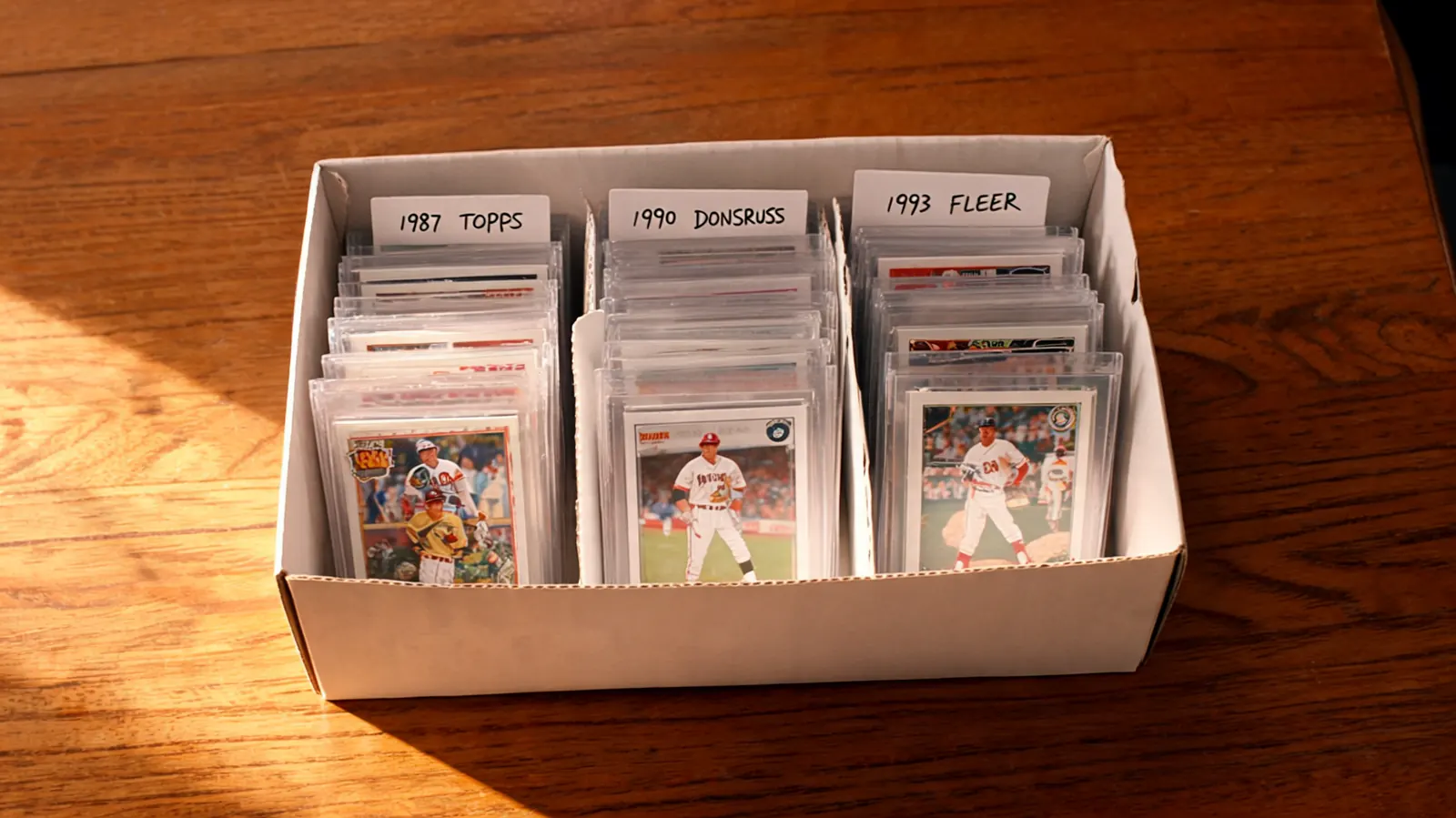
I have been collecting baseball cards since I was nine years old. For about fifteen of those years I kept them in shoeboxes. Not because I did not care about them. I just never had a system that made organization feel worth the effort. Then I sat down one Saturday with a 1000-count box of assorted cards, a fresh pack of Ultra Pro top loaders, and a bag of penny sleeves, and built the system I wish someone had handed me back then. If your collection is anything like mine was, this guide will save you a weekend of frustration.
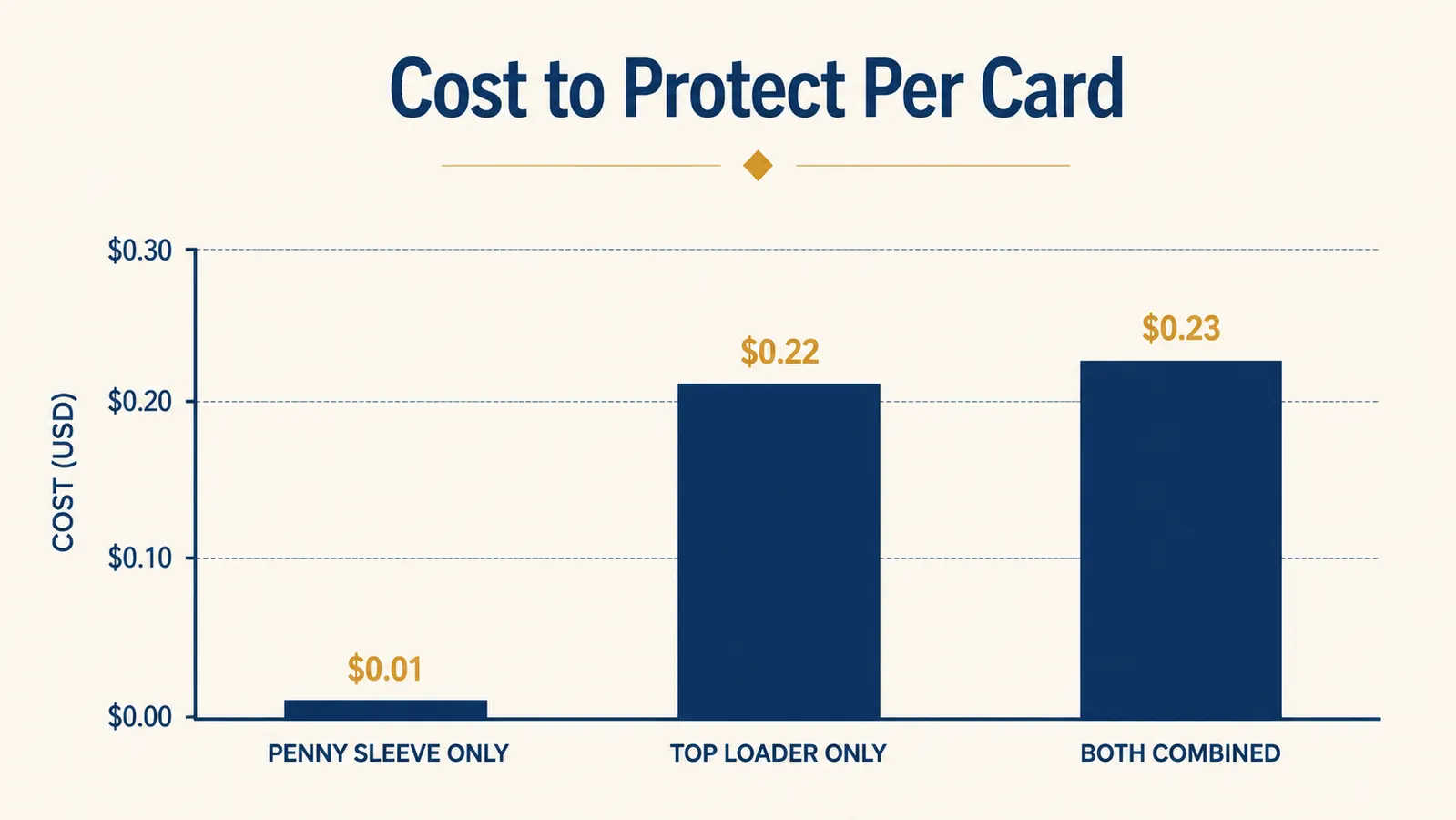
The Ultra Pro 3x4 top loader is the foundation of the whole system. At roughly $5.50 for 25 loaders, you are paying about $0.22 per card in rigid protection. Add a penny sleeve at $0.01 per card and your total cost to protect one card properly is $0.23. On a 1,000-card collection that is $230 in supplies. On a 500-card collection it is $115. Those numbers feel real when you think about what a single rookie card in genuinely mint condition can fetch compared to the same card with a corner ding from being loose in a box.
The top loader most collectors start with, and most never stop using
Ultra Pro 3x4 top loaders come 25 to a pack and fit standard-sized baseball, basketball, football, and hockey cards. Over 15,000 Amazon reviews at 4.8 stars. Check today's price before you buy a cheaper brand you will regret.
Amazon Check Today's Price on Amazon →Step 1: Sort by Sport, Then Team, Then Year, Then Card Number
Before a single sleeve goes on a single card, sort everything into piles first. The hierarchy that works for a mixed baseball collection is: sport first (baseball separate from Pokemon and MTG if you collect those too), then team, then year within that team, then card number within that year. If you try to sleeve and sort at the same time you will handle every card twice as many times and double your odds of introducing a surface scratch.
For a 500-card baseball collection, this sort step takes about 30 to 40 minutes. For 1,000 cards it is closer to an hour. Do it on a clean, soft surface, ideally a microfiber mat or a folded bath towel. Clear off the kitchen table completely. Rubber bands around team stacks during sorting are fine for short sessions, but remove them before storage because they leave marks over time on older cardboard stock.
If your collection spans multiple sports or TCG types, label a paper plate or small tray for each sport before you start. Cards fall off piles. Labeled trays hold the sort structure even if you need to walk away mid-session.
Step 2: The Penny-Sleeve-First Rule
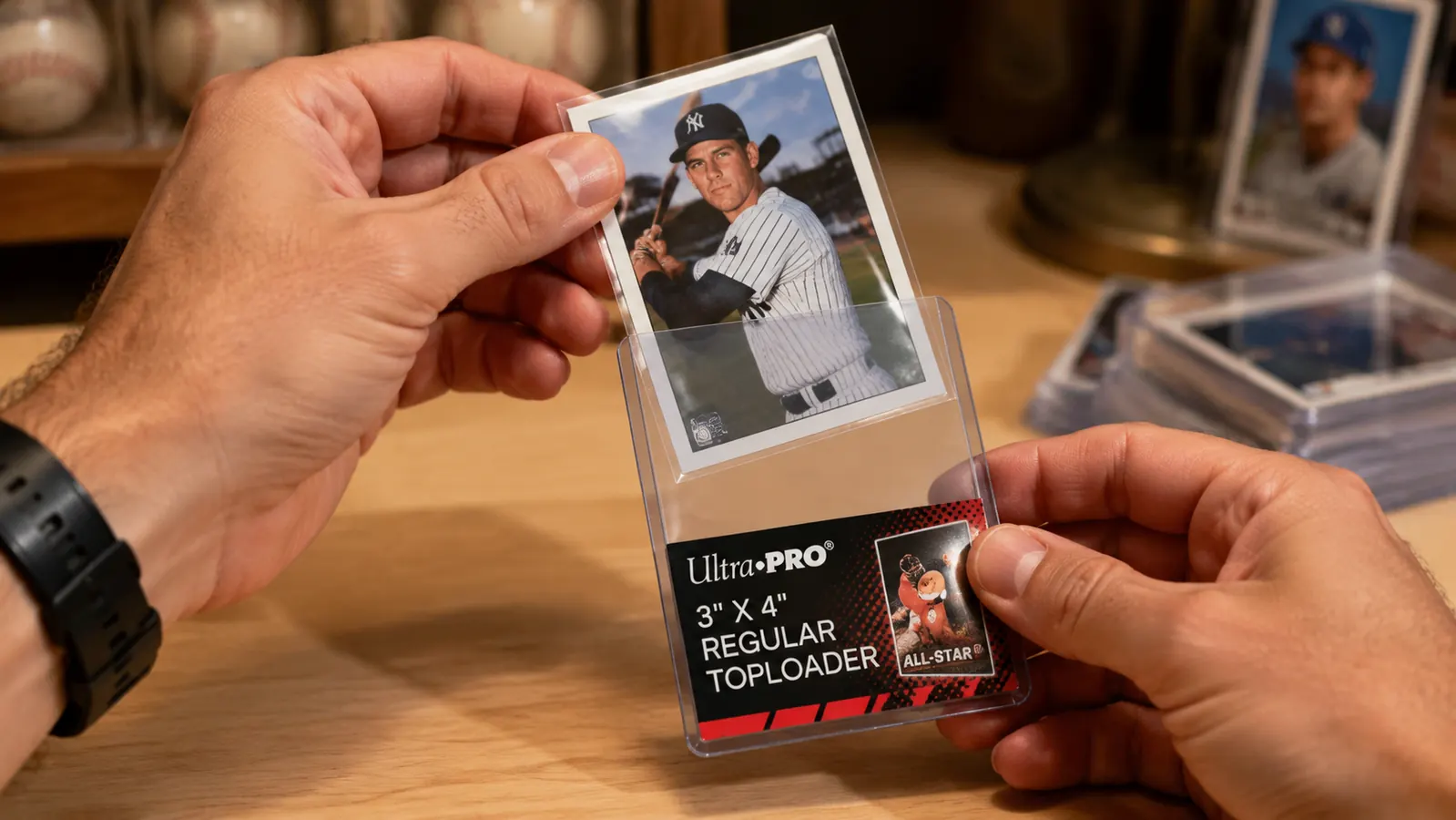
Never put a card directly into a top loader without a penny sleeve first. I know it feels redundant. It is not. The tight tolerances on a standard 35-point top loader mean the card can rattle slightly when you tilt the holder sideways. Over hundreds of removals and reinspections, that rattling translates into micro-abrasion on the card surface. A penny sleeve eliminates the play inside the loader and keeps the card centered. For any card worth more than about $5, skipping the penny sleeve is a decision you will notice the moment you pull it for PSA submission and see the surface under a loupe.
To sleeve: hold the card by its edges, slide it into the penny sleeve with the front face toward the open end, then fold the sleeve edge back about a quarter inch before dropping it into the top loader. The fold prevents the sleeve from riding up inside the loader and obscuring the top edge of the card when you look in.
One penny sleeve per card. One top loader per sleeve. In that order, every time. The collectors who skip this step are the ones messaging me asking why their card came back with a grade lower than they expected.
Step 3: Match the Right Top Loader Thickness to Your Card
Standard baseball cards from the modern era run between 20pt and 35pt thickness. Ultra Pro's standard 3x4 top loader, ASIN B004KHV24W, is rated for cards up to 35pt and handles the vast majority of vintage and modern baseball cardboard without issue. Where you will run into problems is with thick relics, jersey cards, or certain Pokemon and MTG cards that push into the 55pt to 130pt range.
If a card does not slide smoothly into the loader, do not force it. You will either crack the loader lip or bend the card corner trying to muscle it in. Ultra Pro makes thicker-gauge loaders in 55pt, 75pt, 100pt, and 130pt sizes. For a standard baseball collection, you will probably never need anything thicker than 55pt, and even that is reserved for thick relics. Keep a handful of 55pt loaders in your supply box for surprises. The 35pt loaders handle about 90 percent of what most baseball collectors own.
Step 4: Use Team Bags to Group Cards for Trading and Transport
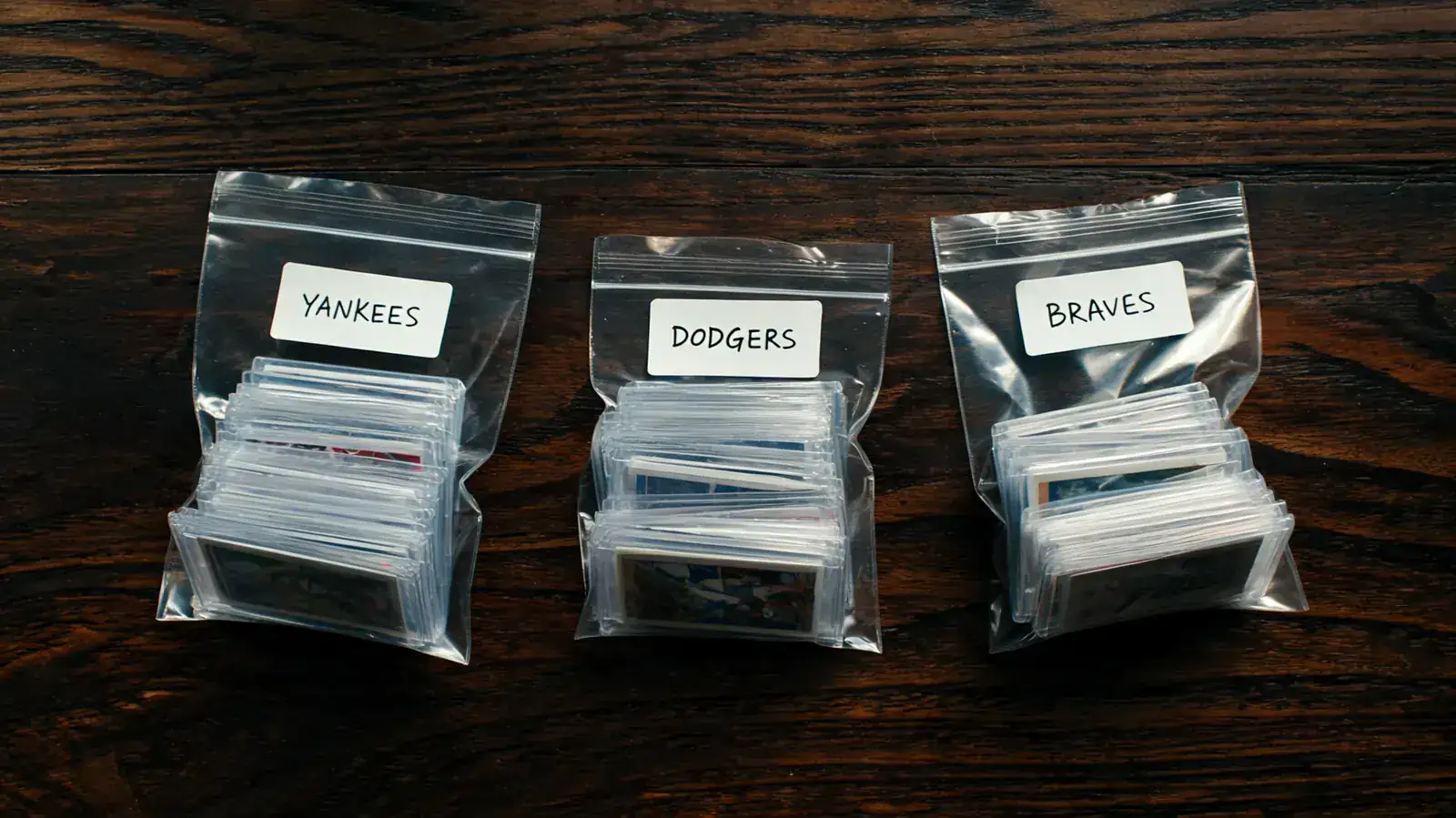
Once cards are in loaders, team bags are the next layer. A team bag is a resealable polypropylene bag sized to hold a stack of top-loaded cards without the cards sliding around. I use them to keep each team's cards together as a unit inside the storage box. Instead of loose loaders shifting around during transport, each team's stack stays contained.
This step pays off most at shows and trades. If someone wants to look through my Red Sox cards, I pull one team bag and hand it across the table. Nothing else in my box gets touched or shifted. When they hand it back, it drops right back in the same slot. For trade show prep specifically, I write the team name on a small label and stick it on the outside of the bag so I can pull the right one without opening each bag to check.
Team bags typically run about $5 to $8 for a pack of 100. They are not a primary Amazon affiliate product for this site, but any card supply retailer carries them. They are worth the small investment. I go through about 30 to 40 per 1,000 cards organized (roughly one bag per team cluster plus extras for overflow).
Step 5: Label Dividers Inside the Storage Box
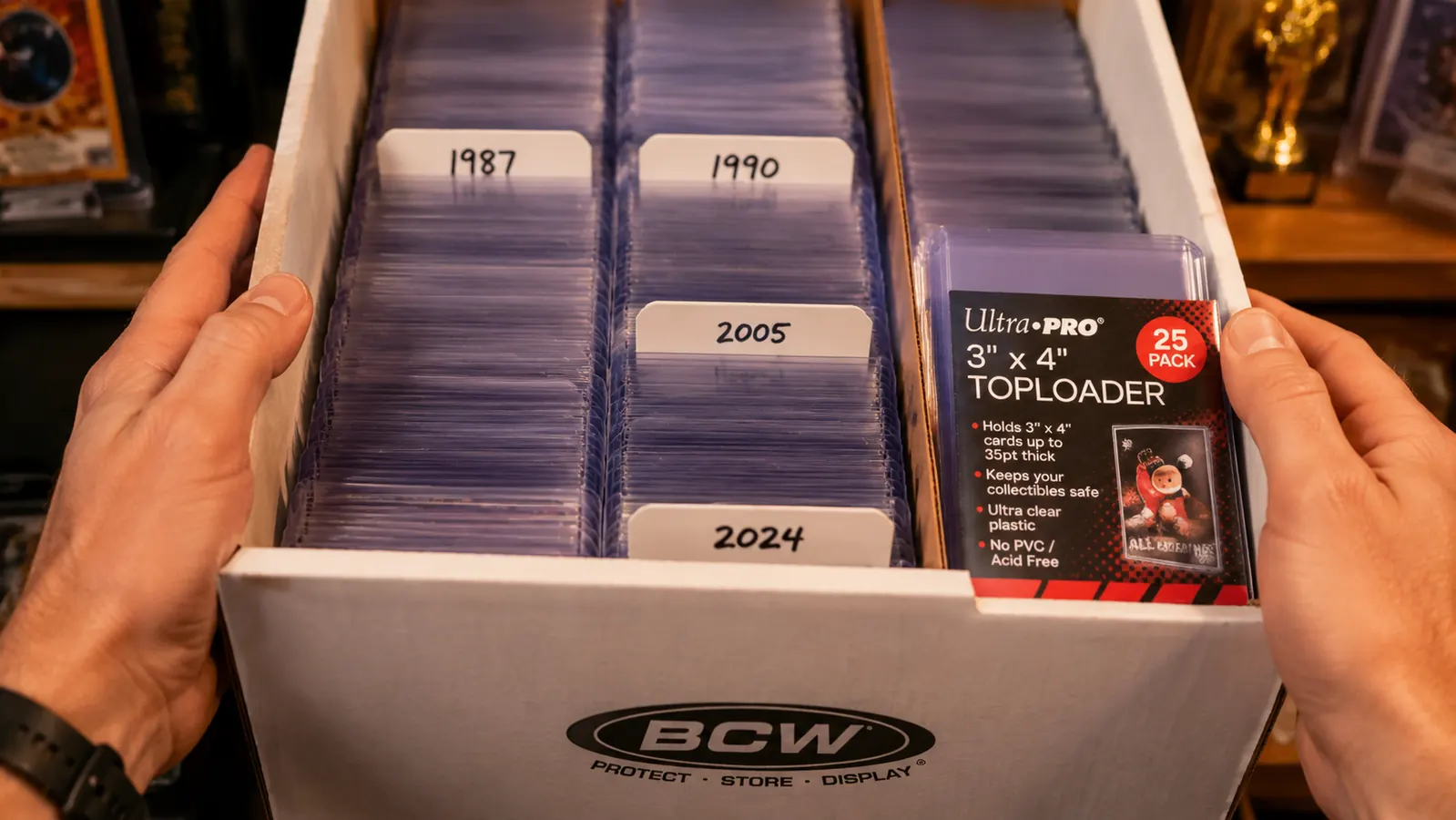
Dividers are how you turn a box of cards into a filing system. Cut standard index cards in half lengthwise and write the year or team name on each one. I write in Sharpie on the top third of the card so the label sticks up above the top loaders when the box is closed. When I open the box, I can read every divider tab without pulling a single card.
The order I use: primary sort by team alphabetically, secondary sort within each team section by year ascending. So the Atlanta Braves section goes 1987, 1993, 2002, 2005, 2021. The Chicago Cubs section does the same. This lets me find any specific card by thinking: team first, then decade. I can get to any card in my 800-card baseball collection in under 90 seconds using this system.
For larger collections organized strictly by year across all teams, flip the sort: year as the primary divider, team alphabetically within each year. Which approach you choose depends on whether you think of your collection team-first or year-first. Both work. Pick one and commit to it before you start filing, because switching midway means relabeling everything.
Step 6: Put Top-Loaded Cards Into a Proper Storage Box
Top loaders in a shoebox are better than nothing. Top loaders in a proper card storage box are meaningfully better than that. The reason is fit. A standard shoebox is too wide for a single row of 3x4 top loaders, so the cards fall sideways and put pressure on each other. A purpose-built card storage box holds loaders snug and upright so the cards do not lean or shift during storage or when you pull the box off a shelf.
For a collection of 500 to 1,000 top-loaded cards, a BCW 1600-count or 3200-count cardboard storage box works well and costs under $10. For a larger collection or for anyone who wants something that stacks cleanly and survives being moved, the BCW Super Monster plastic storage box holds up to 5,000 standard cards and is designed to stack without crushing the box below it. I have been using a BCW plastic box for my organized top-loader section for about three years. The lid closure is solid, the walls do not bow, and it has survived four moves between apartments without the cards shifting inside. That said, a $7 cardboard box from BCW is a perfectly fine starting point if you are not ready to spend $55 on the plastic version.
One practical note: top loaders take up about twice the space of unsleeved cards. A box that holds 5,000 raw cards holds roughly 2,000 to 2,200 top-loaded cards in penny sleeves. Plan your box capacity accordingly. For 1,000 top-loaded cards, a 3200-count box gives you comfortable room plus space for dividers.
Step 7: The Binder-Overflow Rule for Cards Not Quite Worth a Top Loader
Not every card in a collection needs a top loader. Commons, duplicates you intend to trade away, and cards with existing condition issues that you are keeping purely for sentimental reasons do not need $0.22 worth of rigid plastic. Forcing a top loader on every card in a 3,000-card collection inflates your supply cost and makes the box significantly heavier and harder to manage.
My rule: if the card is worth more than $3 in current condition, or if it is a player I specifically collect, it gets the full penny-sleeve-plus-top-loader treatment. Everything below that threshold goes into a 9-pocket binder page in a penny sleeve only. The binder handles the low-value bulk. The top-loader box handles the cards I actually care about. Keeping those two populations separate also makes it much easier to do a collection audit later because everything in the box is immediately a card you have decided has some value, even if it is just sentimental.
A Vault X 9-pocket zip binder with 20 pages holds 180 cards and keeps them accessible without the bulk of a top-loader box for lower-tier cards. If you want a guide specifically on binder organization, I have a full walkthrough on how to organize trading cards in a binder that covers Pokemon, MTG, and baseball together.
The full system in summary: sort before you sleeve, penny sleeve before you load, match loader thickness to card thickness, use team bags to group for transport, label every divider so you can navigate without pulling cards, put everything in a snug storage box, and let binders handle the overflow below your threshold. From a pile of 1,000 unsorted baseball cards, running this system start to finish takes me about four hours. The result is a collection I can browse, trade from, and pull PSA candidates out of without disturbing anything else. That kind of access is what makes collecting actually enjoyable rather than just an expensive version of owning a pile of stuff.
Get the top loaders that handle this whole system without cracking or yellowing
Ultra Pro 3x4 rigid top loaders are the industry standard for standard-size baseball, basketball, football, and hockey cards. 25 per pack, 4.8 stars across more than 15,000 reviews, and compatible with every penny sleeve brand on the market. Check today's price on Amazon.
Amazon Check Today's Price on Amazon →