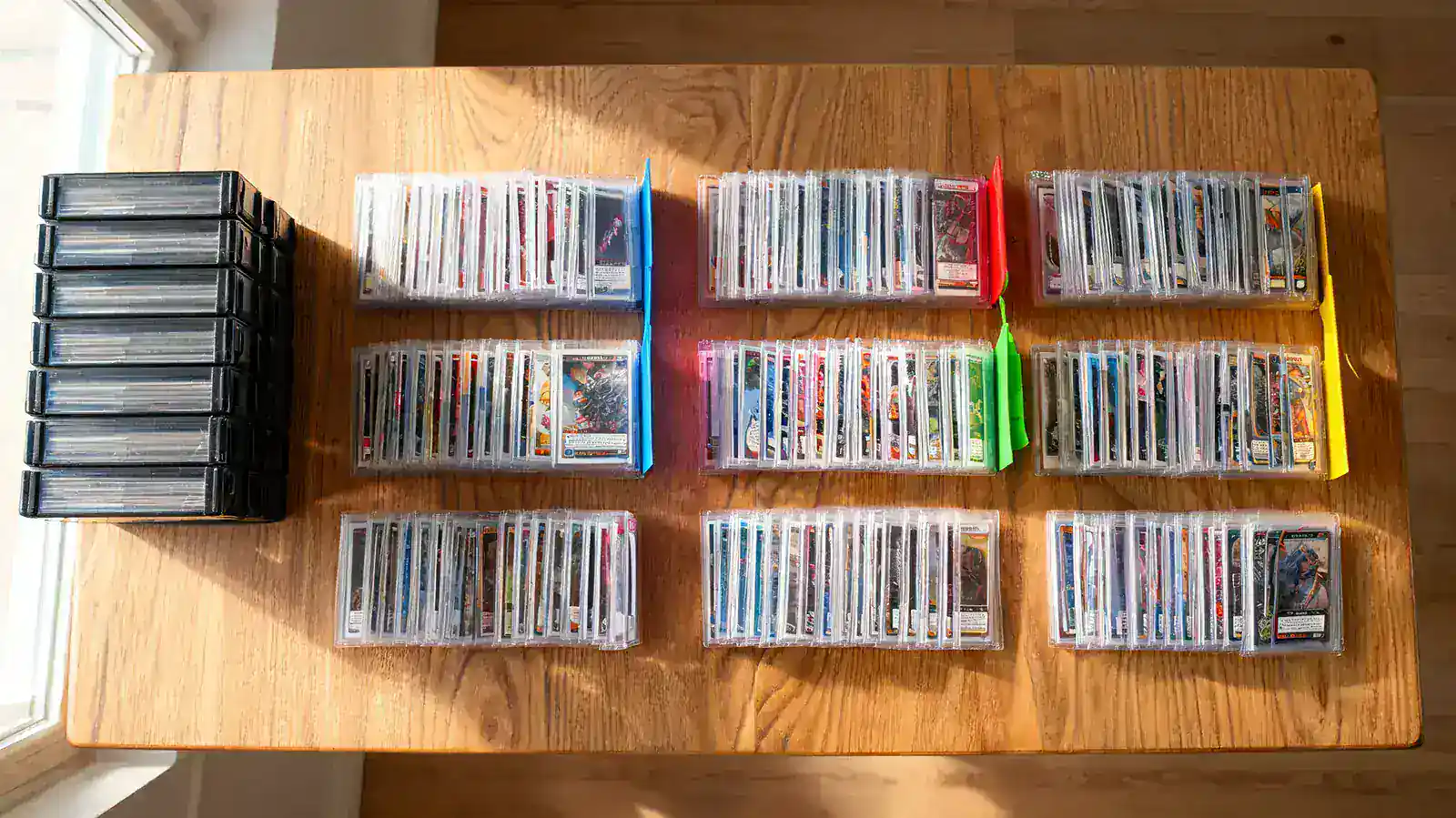
I hit 5,000 cards somewhere around year four of collecting, and for about six months after that I had no idea what I actually owned. Cards were split across three shoeboxes, a cardboard 800-count box with a warped lid, a binder full of random doubles, and a pile on my desk that I kept meaning to sort. Nothing was labeled. Nothing was sleeved consistently. And I definitely pulled out a card one afternoon that had a crease I did not put there. That was the moment I decided to build a real system.
What I am going to walk you through here is the exact process I used to consolidate everything, triage the collection, sleeve and protect every card that mattered, and land it all inside BCW Super Monster boxes where it has stayed safe ever since. I will give you real numbers: how many sleeves you need, how many top loaders, what the whole thing costs, and which environmental mistakes will quietly ruin cards over a few years even if you never touch them. This is not a theoretical guide. I have done all of this, made most of the mistakes, and now my collection is in better shape than it has ever been.
If your cards are in shoeboxes or warped cardboard, this is the box that fixes it
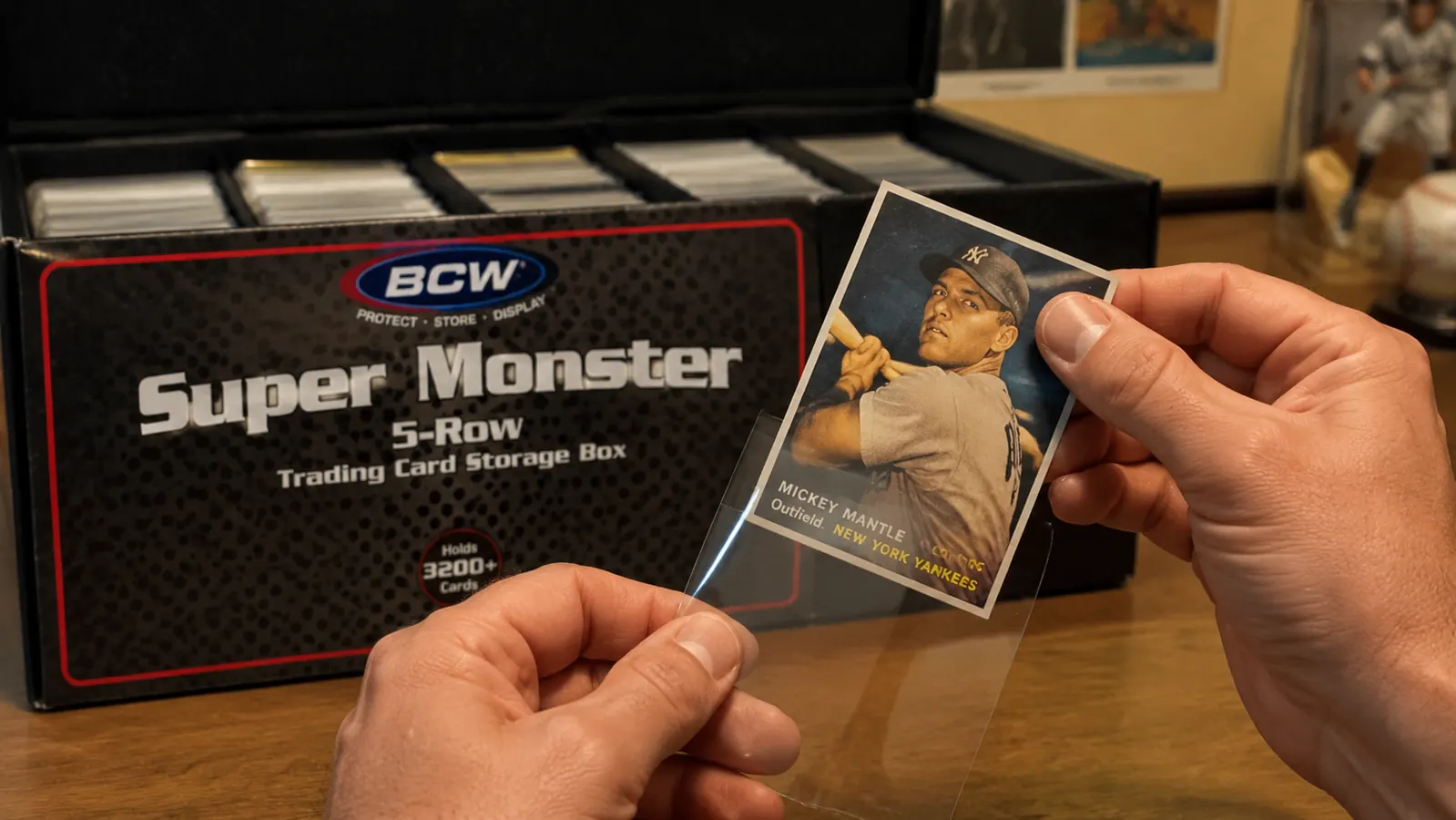
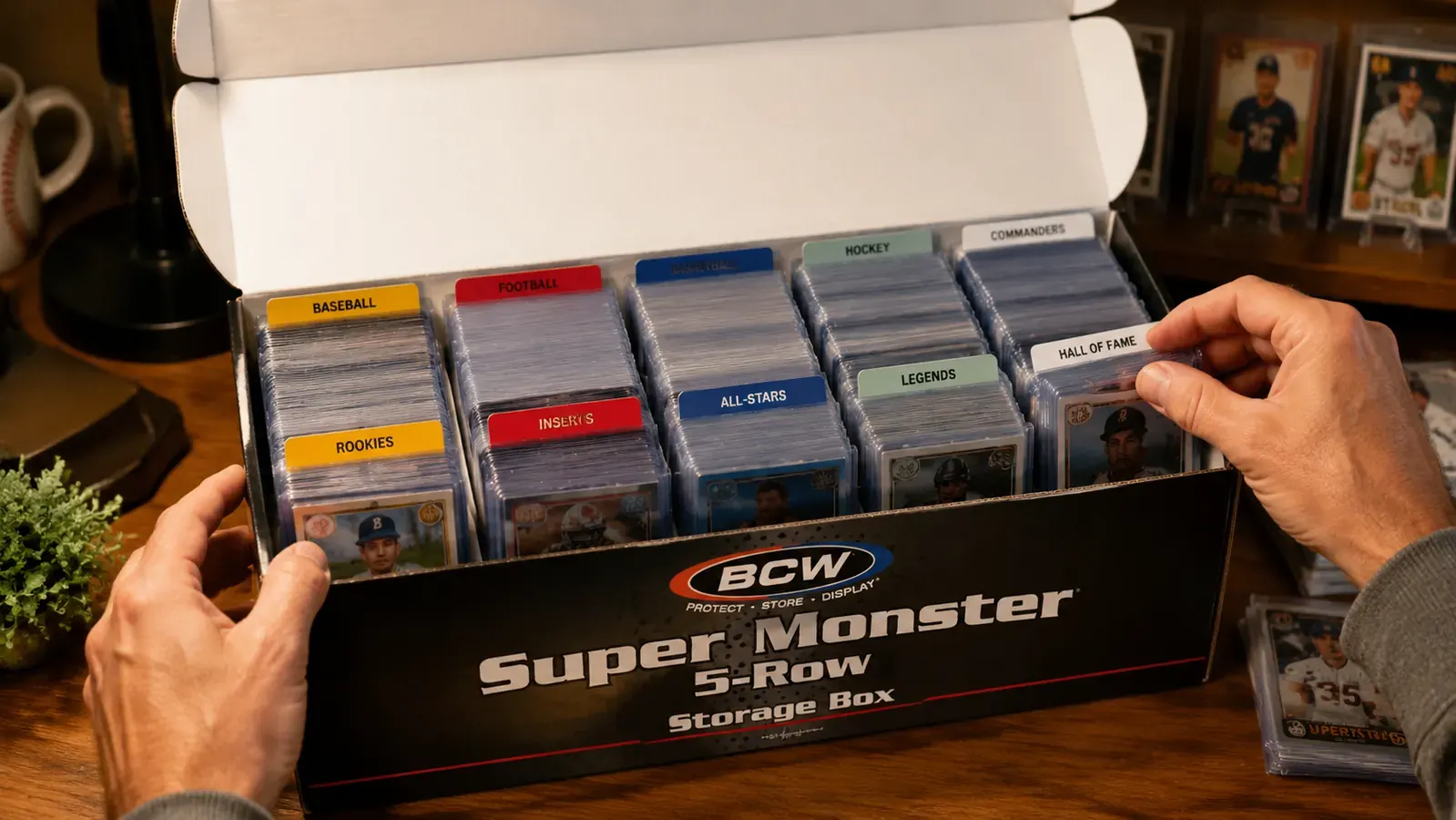
The BCW Super Monster holds 5000 standard-size cards across five rows. Rigid plastic, stackable, and it comes with dividers. This is what I use for my bulk collection.
Amazon Check Today's Price on Amazon →Step 1: Inventory and Triage Before You Touch a Single Sleeve
Do not start buying supplies until you know what you actually have. Pull everything out and sort into three piles: keep and protect, sell or trade, and bulk. For most collectors the split lands somewhere around 20 percent keep, 30 percent sell, and 50 percent bulk commons. Your numbers will be different but the exercise matters because it tells you exactly how many sleeves and top loaders to order.
For your keep pile, ask yourself a simple question: would I be annoyed if this card got a corner ding or a surface scratch? If yes, it goes in the keep pile and gets a sleeve. Your sell pile should go to COMC, eBay, or a local shop as soon as possible. Holding cards you do not want is how you end up with 5,000 cards you do not actually care about. The bulk commons can go into boxes without sleeves, sorted by set or team, ready to sell by the lot or use for trades.
After doing this with my own collection I found I had roughly 1,800 cards I wanted to keep and protect, about 800 I could move, and close to 2,400 commons I was keeping for trade bait. Knowing those numbers upfront saved me from buying twice as many sleeves as I needed.
Step 2: Sleeve Every Card Worth Keeping (Starting With Penny Sleeves)
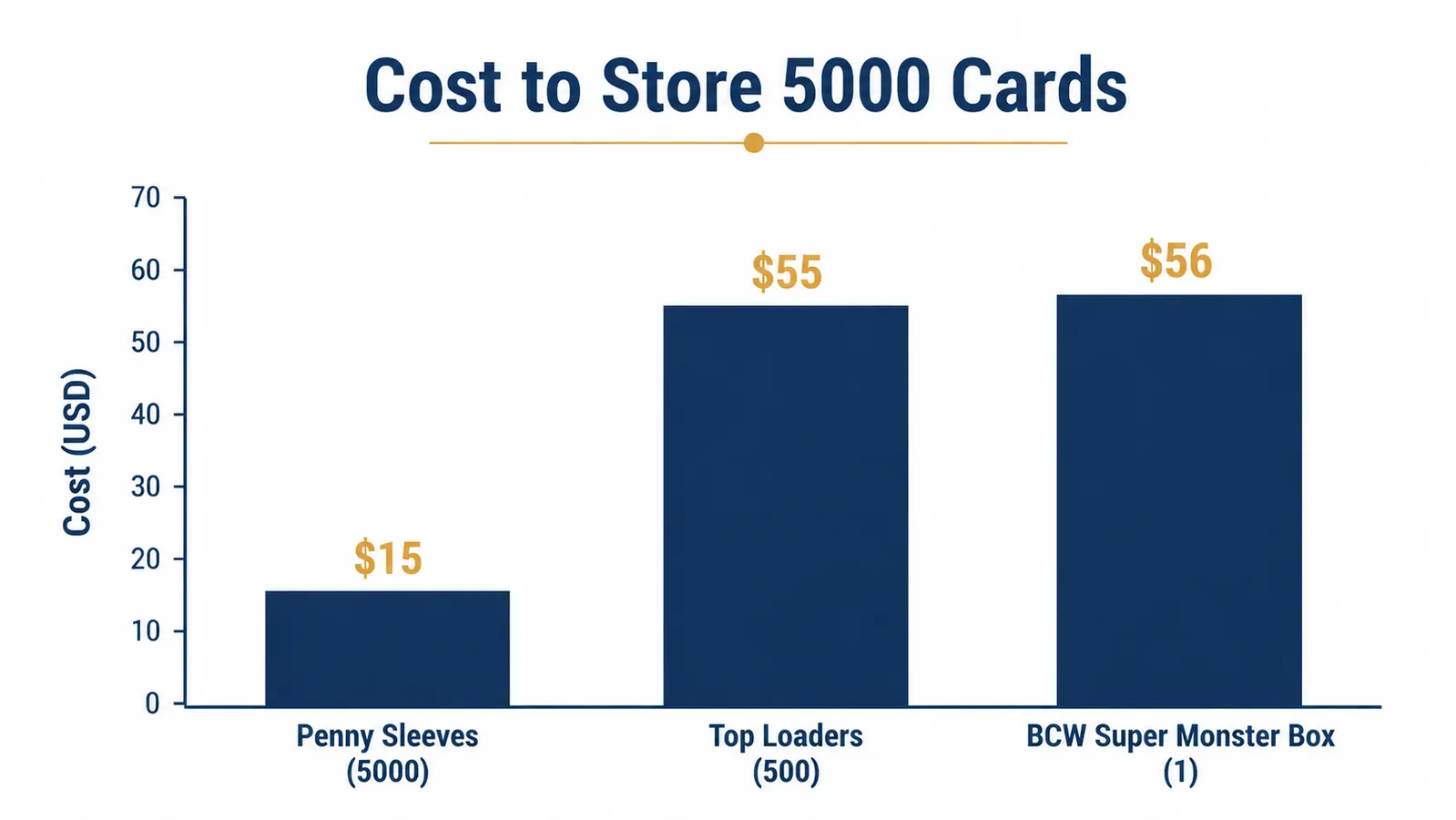
A penny sleeve goes on every card in your keep pile. No exceptions. The sleeve does not protect against bending, but it protects against surface scratches, moisture transfer from your fingertips, and the edge-to-edge abrasion that happens when cards shift inside a box. For 5,000 cards you will want at least 5,000 penny sleeves, but I always order 10 to 15 percent extra because they tear, they get dusty, and you will find more cards to protect once you start. A 5,000-count case of penny sleeves runs about $12 to $15 depending on the brand.
Technique matters more than people realize. Slide the card in face-down so your thumb does not contact the front surface. Press the sleeve down from the back to avoid air bubbles. For standard baseball cards and Pokemon cards, a standard penny sleeve fits fine. For thicker ETB promos or memorabilia cards, you will need a thicker sleeve, usually listed as 130pt or 180pt compatible. I keep a small stock of thick sleeves separate from my regular supply so I do not have to hunt for them when a thick card comes up.
Step 3: Use Top Loaders for Cards Worth More Than About $5
A penny sleeve alone is not enough for anything valuable. The sleeve protects the surface but it does not stop a card from bending if something heavy lands on the box or the lid gets pushed down. That is where top loaders come in. I use the Ultra Pro 35pt standard top loader for about 90 percent of my top-loaded cards. They are rigid, they fit a penny-sleeved card without being sloppy, and they stack cleanly inside a BCW box.
For a 5,000-card collection where 10 percent of your cards are worth protecting with a top loader, you are looking at around 500 top loaders. A 25-count pack of Ultra Pro 35pt loaders is about $5 to $6, so 500 loaders will run you roughly $100 to $120. That might feel like a lot until you do the math on what you are protecting. Thicker relics, autos, and manufactured patches need a thicker top loader, usually 130pt or 180pt. I keep a stack of thick loaders on my desk and do a quick thickness check whenever I am handling anything that feels heavier than a standard base card.
The sleeve protects the surface. The top loader protects the structure. You need both for anything that matters.
Step 4: Pack Cards Into the BCW Super Monster Box
The BCW Super Monster 5-row storage box holds 5,000 standard trading cards. That is the headline number, and it is accurate for unsleeved cards. Once you start sleeving and top loading everything, that number drops. With penny sleeves on 1,800 cards and top loaders on 500 of them, I found I could fit about 4,200 to 4,400 cards total across the five rows. I use two BCW Super Monster boxes: one for my protected keep pile and one for bulk commons. That setup has worked cleanly for about 18 months now.
A few packing rules I learned the hard way. Do not overstuff a row. Cards should move smoothly when you push down from the top, not require force. If you are forcing cards in, you are bending them at the top edge without realizing it. Leave about a half-inch of space at the top of each row and use the included dividers to prevent the cards from leaning. Leaning is how you get warped cards at the back of a row. Orientation is vertical always, never horizontal stacking inside the row. Use one divider at the front and one at the back of each row as bookends, then add dividers every 100 to 150 cards to prevent lean in the middle.
You can read my longer breakdown of the BCW Super Monster box in my BCW Super Monster storage box review, including notes on lid strength, stackability, and how it holds up after repeated opening and closing.
Step 5: Climate Considerations (Not the Garage, Not the Attic)
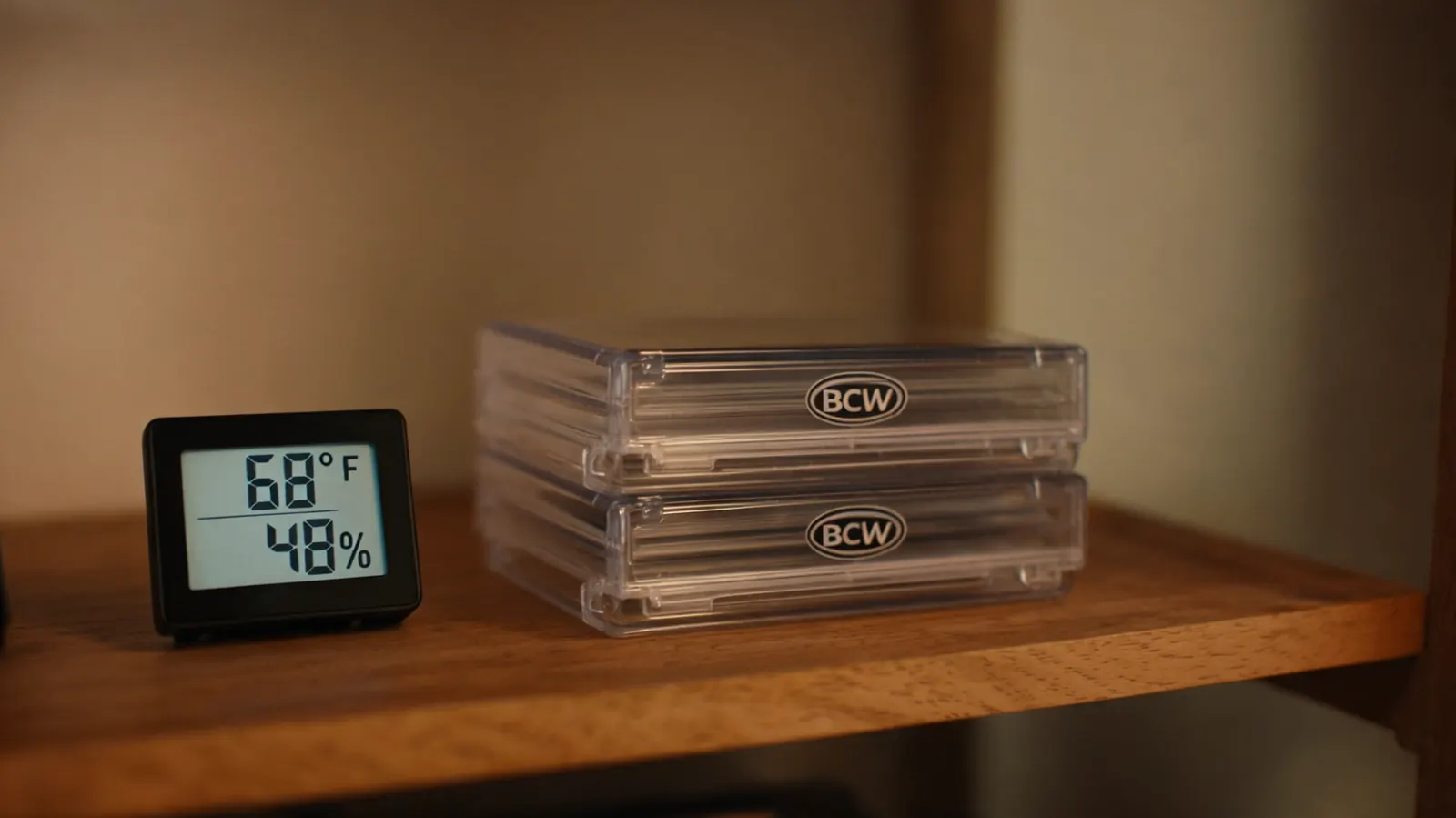
This is the one people skip and then wonder why cards they bought in gem-mint condition look beat up after two years. Heat and humidity are the two main killers. Heat causes cards to warp. Humidity causes cards to absorb moisture, which leads to rippling and long-term surface degradation. Cold in itself is less dangerous than temperature swings, but rapid swings cause condensation inside sealed boxes, and condensation is the worst of all.
Target storage environment: 65 to 70 degrees Fahrenheit, 45 to 55 percent relative humidity. A bedroom closet or interior shelf in a climate-controlled room gets you most of the way there without any additional equipment. Garages, attics, and outdoor storage sheds are off the table. A basement can work if you run a dehumidifier and monitor the numbers. I keep a small digital hygrometer from Amazon ($10 to $12) on the shelf next to my boxes. It cost almost nothing and gives me a reading every time I walk by. If humidity starts creeping above 55 percent I run a small dehumidifier or move the boxes to a different room. Silica gel packs inside the box add a layer of insurance but they are not a substitute for storing in the right environment to begin with.
Step 6: Build a Labeling System You Will Actually Use
A storage box full of unlabeled cards is barely better than a shoebox. The whole point of getting organized is being able to find a specific card in under two minutes. I use a simple three-tier labeling system. Each BCW box gets a label on the outside front that says what category it contains, for example: 'Baseball -- Keep Pile, 2020-2024' or 'Pokemon -- Bulk Commons.' Each row inside the box gets a row-level label on the front-facing divider: 'Row 1: Base Set, A-M' or 'Row 3: Autos and Relics.' And within each row, the colored BCW dividers act as alphabet or set separators.
For the labels themselves I use a Brother P-Touch label maker because the labels are durable and do not curl or peel off in storage. A Sharpie on a sticky note technically works but the adhesive fails over time and the ink fades. You do not have to go digital with a spreadsheet unless you want to. I know collectors who track every card in a Google Sheet and collectors who just know their boxes well enough to pull any card in 60 seconds. Either works as long as the physical labeling is consistent.
For a system that covers organizing by sport and team, my guide on how to organize baseball cards with top loaders goes deeper on the sorting logic and works just as well for Pokemon and MTG with minor adjustments.
Step 7: Run a 6-Month Maintenance Check
A storage system is not a set-and-forget situation. Every six months I pull each box, check the humidity reading in the room, and do a visual scan through each row. I am looking for a few specific things: any cards that have developed a warp (usually means humidity crept up at some point), sleeves that have yellowed or gotten hazy (time to re-sleeve), and any top loaders that have cracked or gone cloudy (replace them, they are cheap). I also check the box lids for any stress cracks, especially if I have been stacking boxes. BCW lids are sturdy but repeated stacking under significant weight will eventually cause hairline cracks at the corners.
The maintenance check is also when I review the triage question again. Cards I thought I would sell eventually get listed. Cards I no longer care about move out of the protected rows and into bulk. Keeping the keep pile lean means the storage system stays manageable and you do not wake up in two years with 5,000 cards you are protecting that you stopped caring about.
Step 8: When to Go From One Box to Multiple Boxes
One BCW Super Monster box holds roughly 4,000 to 4,400 sleeved and top-loaded cards. If your keep pile is under 3,500 cards you can get away with one box for protected cards and one for bulk, which is exactly the two-box setup I run. Once your protected collection starts pushing 4,500 or more, split by category instead of trying to compress everything into one box. I now have three boxes: one for baseball, one for Pokemon and MTG, and one rotating bulk commons box I sell or trade from on a regular basis.
Do not try to use one giant monster box to hold everything without dividers. The rows are there for a reason. A single massive unsorted row of 1,000 cards puts enormous pressure on the cards at the bottom of the stack and makes finding anything a card-by-card dig. The five-row design of the BCW Super Monster is an asset, not just a capacity number. Use all five rows intentionally and your collection will be easier to manage at 5,000 cards than most people's are at 500.
What Else Helps
A few small purchases that have made a real difference in my setup: a box of colored dividers beyond what BCW ships in the box (Amazon sells them in bulk for about $8), a small digital hygrometer for humidity monitoring, and a label maker. Total additional spend is under $25 and those three items reduce the frustration of using the system by a significant amount. For the most valuable cards in my collection, anything I would consider grading eventually, I add a team bag on top of the top loader before putting it in the row. The team bag adds a small amount of extra protection against humidity and keeps the top-loaded card from rattling against neighbors.
Two BCW Super Monster boxes cost less than a single graded slab off eBay. The math makes protecting your raw cards obvious.
The BCW Super Monster box is the only storage piece in this guide you cannot improvise
Penny sleeves and top loaders you can buy almost anywhere. But a 5-row rigid plastic box that stacks cleanly and actually holds 5000 cards is not something you throw together. The BCW Super Monster is what serious bulk collectors use and there is a reason it has over 2600 reviews.
Amazon Check Today's Price on Amazon →