
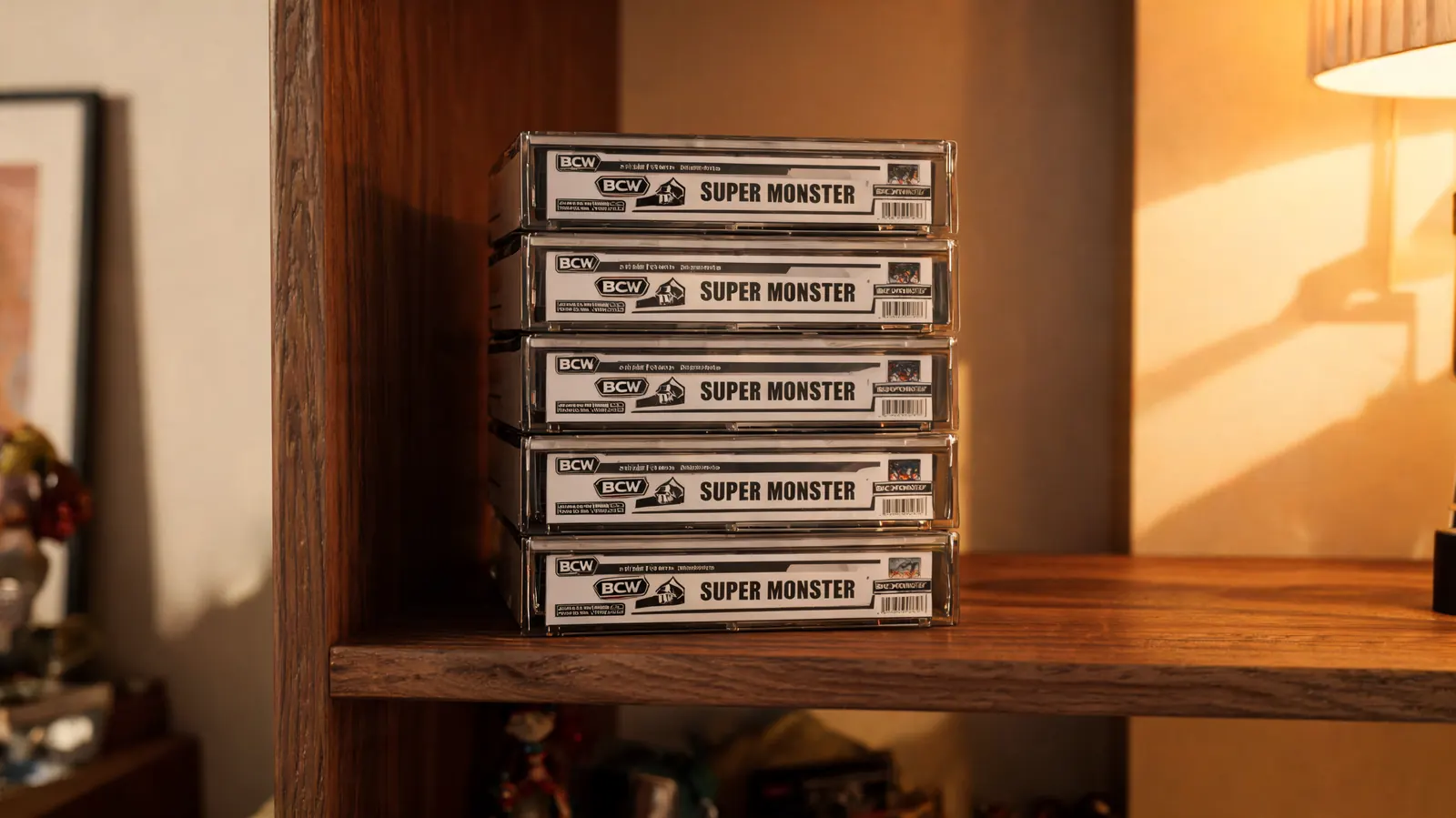
I want to be upfront about something before this review starts. I like BCW Super Monster boxes. I own eight of them. They are still sitting on a shelf in my card room right now, each one holding around 4,800 standard-sized cards. But the reason I am writing this particular article is that three separate people in my local card group bought the same 5-pack based on the Amazon listing, and all three of them had the same complaint within the first week: they expected something different from what showed up. The listing photos are accurate. The specs are accurate. The product itself is fine. But there is a gap between what the listing implies and how these boxes actually live in the real world, and that gap is what I want to fill in.
The BCW Super Monster B01M711J8D is a five-row plastic trading card storage box that holds up to 5,000 standard-size cards. It comes in a 5-pack. The brand has been making storage products for the hobby for decades and the name carries real weight at the local card show level. Rating of 4.6 stars across more than 2,600 Amazon reviews confirms that most people are happy with it. I am mostly happy with it. But mostly is doing a lot of work in that sentence.
The Quick Verdict
Solid bulk storage for serious collectors who know what they're buying, but casual collectors can likely get the same protection from a quality cardboard box at a fraction of the price.
Amazon Check Today's Price →Your bulk cards need a real home. BCW Super Monster delivers that, as long as you go in with eyes open.
Check current pricing on Amazon before you decide. The value calculation shifts depending on whether you're building a permanent archive or rotating a working collection.
Amazon Check Today's Price on Amazon →What Actually Shows Up When the Box Arrives
This is the thing nobody mentions in reviews because it sounds too basic: the BCW Super Monster boxes ship flat. They are not pre-assembled. The 5-pack arrives as a surprisingly large and heavy cardboard shipping box, and inside that box you will find five sets of flat plastic panels, a handful of dividers, and no real instructions. For experienced collectors this is obvious in retrospect. For people buying their first set of plastic storage boxes, it is genuinely surprising.
The flat-ship design makes sense from a logistics standpoint. Pre-assembled 5000-card boxes would be enormous to ship. But the Amazon listing does not make this clear with any prominence, and a meaningful chunk of the negative reviews are from buyers who expected to open the box and start loading cards immediately. Instead, they had to figure out an assembly process that is not intuitive the first time through.
The Assembly Is Fiddly and BCW Knows It
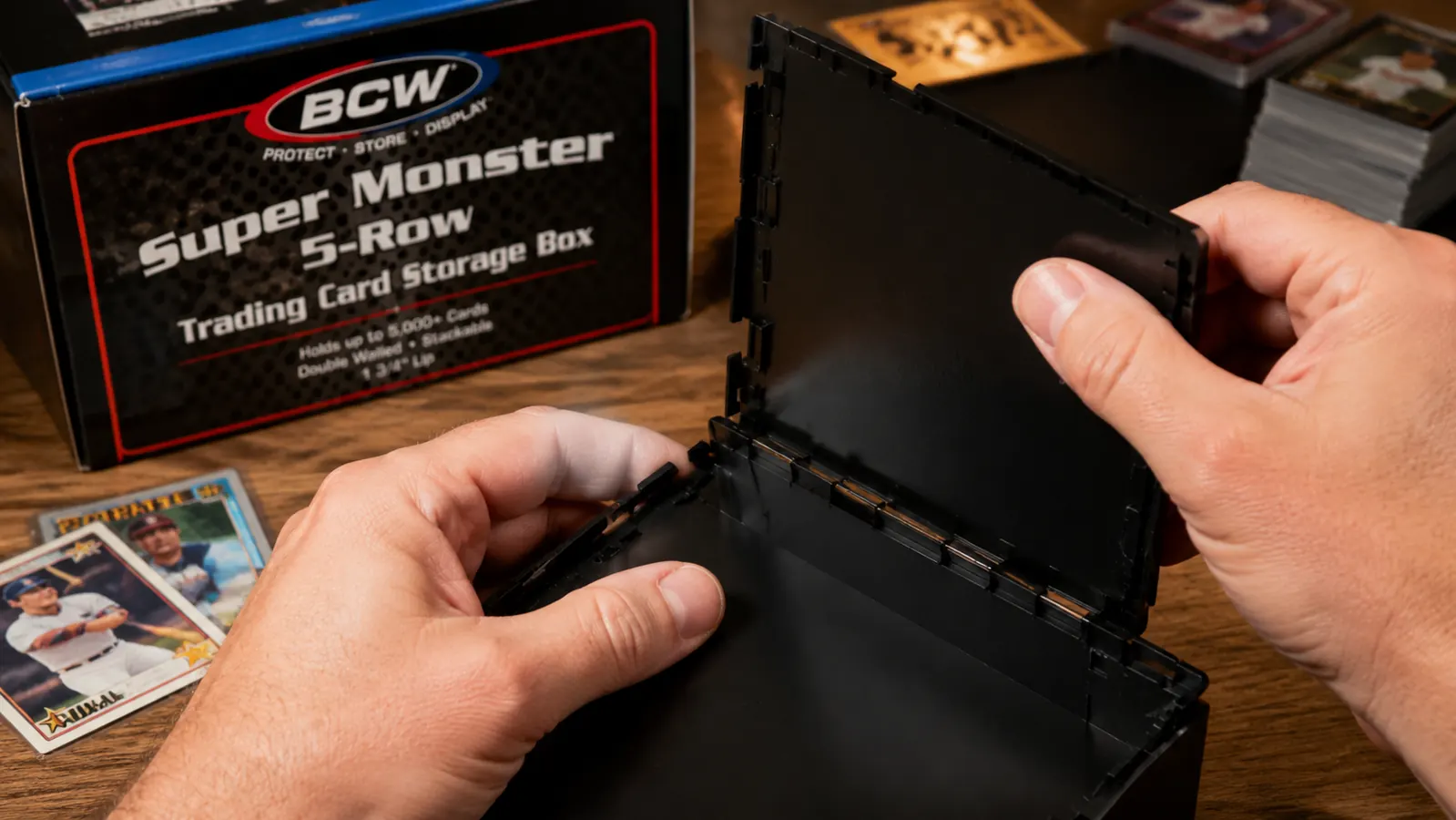
Budget fifteen to twenty minutes per box the first time you assemble one. The tabs that lock the sides to the base and the lid to the body require firm, deliberate pressure and a specific angle that is not obvious from looking at the pieces. You press and it feels like it might snap, then you wonder if you are breaking it, then it clicks in and you feel relieved. Repeat that sequence about sixteen times per box. Experienced BCW owners will tell you the second and third boxes go faster once your hands learn the feel. They are right. But the first box in a batch of five will take you ten minutes minimum, and if you are assembling all five in one sitting plan for an hour.
The tabs themselves are not fragile once seated. I have not had one crack or fail on me, and I have reassembled boxes after moving apartments. But if you are buying these as gifts for a newer collector who has never handled BCW products before, do them a favor and warn them about the process. The one-star reviews that say 'pieces broke' are almost always people who forced a tab in the wrong orientation rather than BCW sending defective units.
The Overstuffing Problem Nobody Talks About
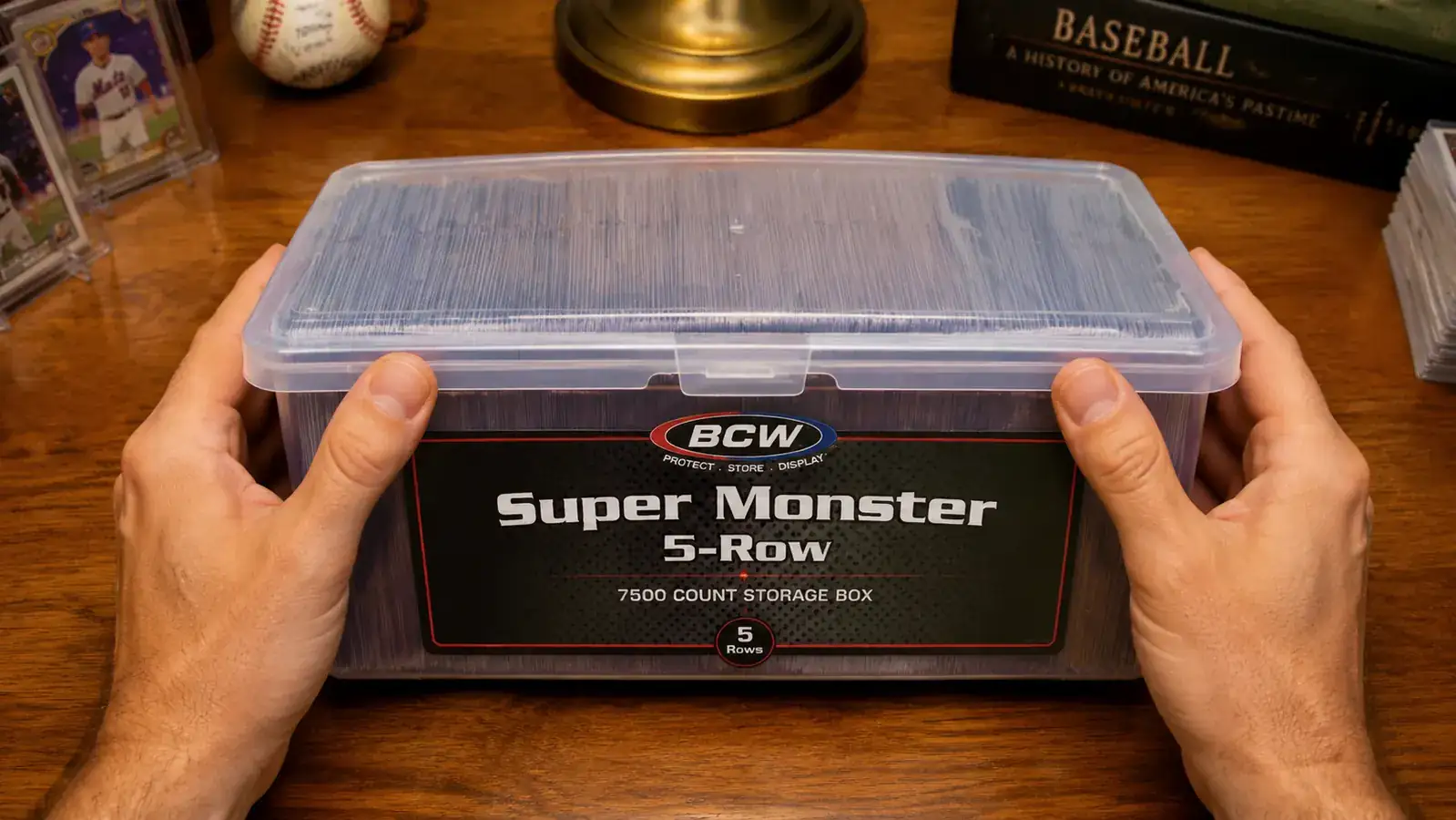
The listed capacity is 5,000 cards. That number assumes unsleeved standard-thickness cards loaded without compression. In practice, most collectors are storing sleeved cards, top-loaded cards, or cards in team bags, all of which add meaningful thickness. A row of penny-sleeved cards takes up noticeably more space than the same row unsleeved. A row of double-sleeved cards (inner sleeve plus outer sleeve) adds even more. Once you start filling rows with sleeved cards you are looking at real capacity closer to 3,500 to 4,200 depending on your sleeve type.
The problem is that some collectors see the 5,000 number and push toward it. When a row gets overstuffed, the first sign is that the divider between rows stops seating properly. The second sign is that the lid does not close flat. It bows. And a bowing lid puts downward pressure on the cards in the top row, which is exactly the kind of sustained pressure that causes subtle corner softening on cards you care about. I lost two cards from a 1993 Topps Gold parallel set to lid-bow compression before I figured out what was happening. Overstuffing is user error, but nothing in the product literature warns you about it.
Dust Protection: Better Than a Shoebox, Not Better Than a Sealed Container
BCW marketing language around these boxes uses terms like 'archival quality' and 'long-term storage.' Those terms are not inaccurate, but they create an expectation of airtight or sealed storage that the boxes do not deliver. The lid fits snugly but it is not gasketed. Dust infiltrates over time, particularly if the boxes sit in a basement, garage, or any environment with airflow. I opened a box that had been sitting undisturbed on a bottom shelf for about eighteen months and found a thin but visible layer of dust on the top cards in each row.
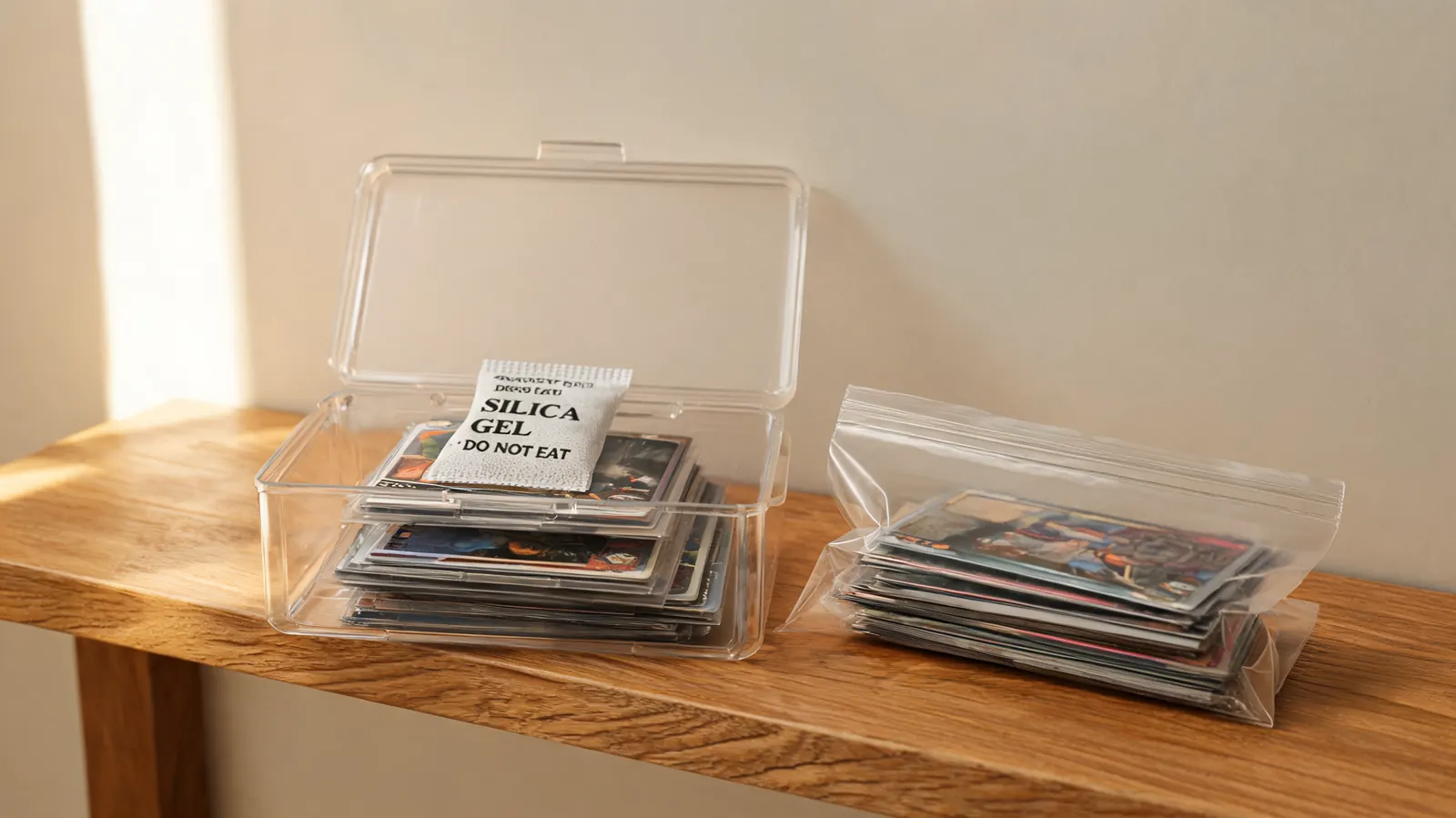
For cards you plan to pull out and look at or sell within a year or two, this is a complete non-issue. The dust protection is meaningfully better than an open cardboard box or a shoebox with a loose-fitting lid. For true long-term storage where you are setting a box aside for five or ten years, I recommend adding a silica gel desiccant packet inside each row, then placing the assembled BCW box inside a sealed 2.5-gallon zip storage bag before putting it on the shelf. It is an extra step, but it is the difference between opening a box in a decade and finding your cards exactly as you left them versus finding surface haze on the top row.
A bowing lid puts real pressure on the top row of cards. I lost two cards from a 1993 Topps Gold set before I understood what was happening. Overstuffing is user error, but nothing in the product literature warns you.
Stacking Limits and the Warping Risk
The BCW Super Monster boxes are designed to stack. The lid has reinforced corners and a slight inset that accepts the base of the box above it. Two high is stable and I have kept stacks of two for years without issue. Three high starts to feel precarious, and I have seen the bottom box in a three-high stack develop a slight warp in the base over time, particularly on shelves that are not perfectly level. Four high is asking for trouble in any environment that sees temperature fluctuation, because the plastic softens slightly in heat and the weight of three boxes above it can push the base out of square.
If your storage space is limited and you need to stack, stick with two high and keep the heavier boxes on the bottom. If you have shelving with more vertical clearance, a single-high row of boxes is always preferable for structural integrity. The warp issue is slow and subtle enough that you may not notice it until you try to set the warped box on a flat surface and find it rocks.
The Price-vs-Cardboard Question: Is BCW Worth 3-4x the Cost?
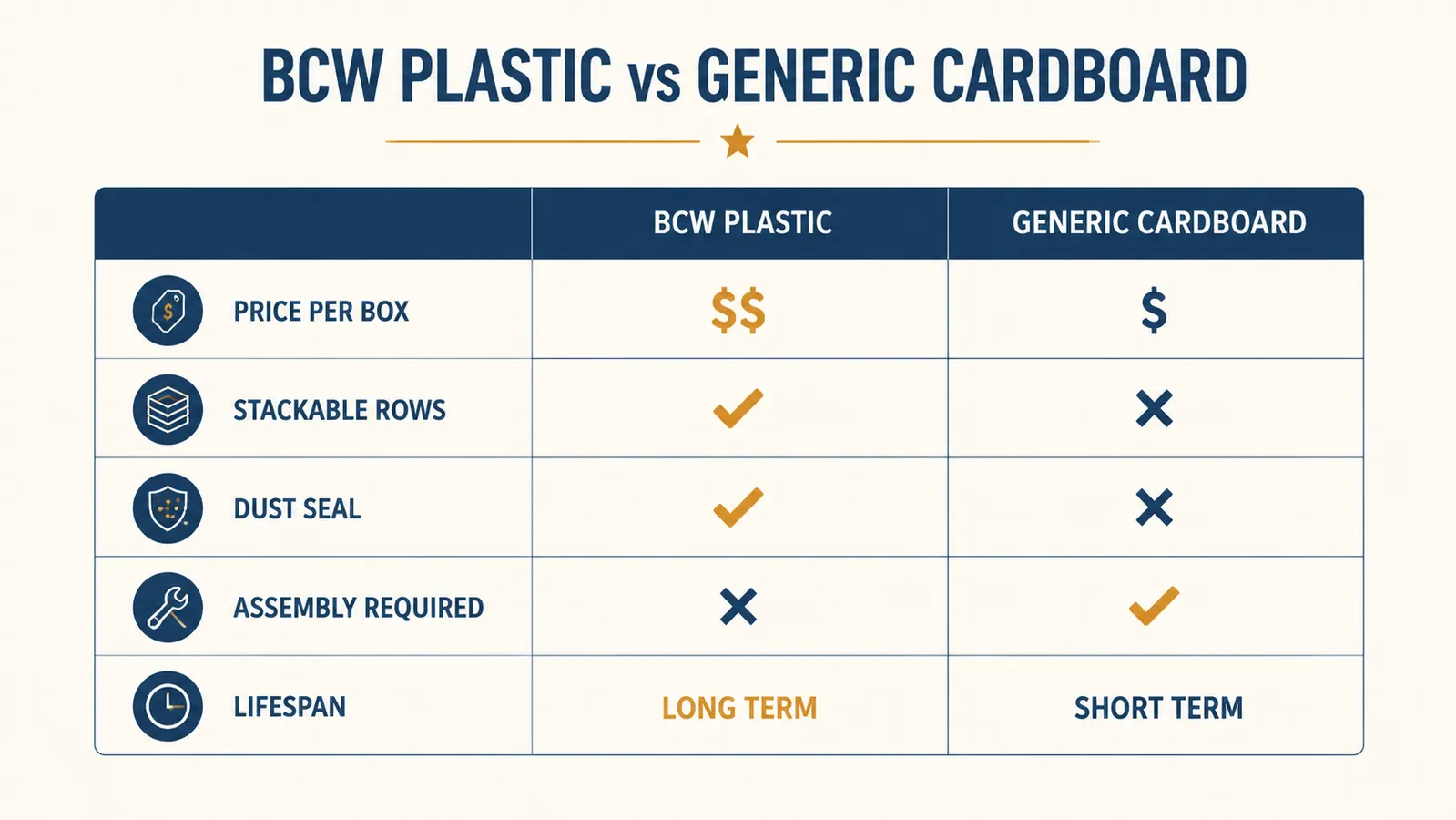
A generic cardboard 3200-count storage box runs anywhere from four to eight dollars depending on where you buy it. A single BCW Super Monster box from the 5-pack works out to roughly eleven to twelve dollars per unit. That is a real price gap. For a casual collector who has two or three thousand cards they want to store tidily and access occasionally, an argument exists that the cardboard box is the correct choice. It holds cards fine. It is stackable, though less rigidly. It costs a fraction as much. And if it gets damaged, you throw it away and buy another one for five dollars.
The BCW case gets stronger as the collection grows and as the individual card values increase. Plastic resists moisture better than cardboard in any environment that sees humidity swings. Plastic does not collapse if a shelf bracket fails. Plastic does not absorb odors from a garage or basement. If you have 15,000 cards and some of them are worth real money, the price premium is easy to justify. If you have 3,000 commons from a 2015 Topps base set and a limited budget, an honest answer is that the cardboard box will serve you adequately.
Here is the honest math against a generic cardboard 3200-count box. The generic costs about half as much, requires no assembly, and is fine for casual storage of low-value commons. But it holds fewer cards (3,200 vs 5,000), the lid is usually loose-fitting, it warps faster under weight in humid rooms, and most generics start to soften and yellow inside two to five years. The BCW Super Monster runs ten to fifteen minutes of assembly per box, holds together for five to ten years even when stacked two high, and resists moisture better. If you want the head-to-head breakdown I wrote a full comparison piece on this exact question.
What Happens When a BCW Box Ages and Shows Wear
I have BCW boxes that are pushing six and seven years old. The oldest ones are starting to show a yellowing at the corners where the plastic has seen the most UV and handling stress. The tabs still lock. The boxes still function. But they no longer look pristine, and if you are the kind of collector who cares about the presentation of your storage setup, this is worth knowing. The plastic BCW uses is not rated for indefinite UV stability, and boxes that sit near a window or under fluorescent lighting will yellow faster than boxes kept in a dark closet.
When a box reaches a point where the lid no longer sits flat due to accumulated wear at the corner tabs, the right move is to transfer those cards to a fresh box rather than continuing to use a compromised one. At the current price point, refreshing a box every six or seven years is still meaningfully more economical than the long-term cost of damaged cards. But it is a maintenance consideration the advertising does not mention.
What I Liked
- Durable plastic construction genuinely outlasts cardboard by years in any environment that sees humidity or temperature swings
- Snug lid provides better dust protection than open or loose-fitting alternatives
- Tabs hold firm once properly seated, assembly becomes fast after the first box
- Interlocking stack design keeps two-high rows stable even during light vibration
- Divider system lets you organize rows by set, sport, player, or year without extra supplies
- Widely available on Amazon with consistent in-stock status, no chasing down specialty retailers
Where It Falls Short
- Ships flat and requires assembly, which is not obvious from the listing and catches first-time buyers off guard
- Assembly tabs are not intuitive and take 10-15 minutes per box the first time through
- Lid bows when overstuffed, which puts real compression pressure on the top row of cards
- Not airtight or gasketed, so dust infiltrates over months in environments with airflow
- Plastic yellows at corners after several years of UV and handling exposure
- Stacking beyond two high risks base warp, limiting density for tight storage spaces
- Price premium over cardboard alternatives is hard to justify for low-value bulk storage
Who This Is For
BCW Super Monster boxes make the most sense for collectors who have crossed a certain threshold of seriousness. If you have more than 5,000 cards and some percentage of them represent real value, whether vintage baseball, first-edition Pokemon, or grading candidates, the plastic construction and the tight lid are worth the price. Same goes if your storage environment has any humidity variability at all. Basements, garages, climate-uncontrolled storage units: these are exactly the situations where cardboard fails and plastic holds. The 5-pack format rewards the collector who thinks about their storage system as infrastructure rather than a temporary fix.
Who Should Skip It
If you have a modest collection of a few thousand cards and they are mostly low-value commons or duplicates you keep for trade fodder, the BCW price premium is hard to justify. A quality cardboard 3200-count box from a reputable maker will hold those cards just fine, costs a fraction of the price, and requires zero assembly. Similarly, if you are shopping for a gift for a casual collector who has never dealt with BCW products before, be aware that the assembly process is going to be a surprise. It is not a dealbreaker but it is a friction point that a pre-formed cardboard box does not have.
Five thousand cards deserve better than a shoebox. BCW gets the job done at a price that's easier to defend once you know what you're actually buying.
Current pricing on the 5-pack fluctuates. Check today's price on Amazon to see whether the per-unit cost is in the range where the upgrade from cardboard makes sense for your collection size.
Amazon Check Today's Price on Amazon →